Accessible web application
SecondYouth.
Less friction. More independence.
An offline-first senior-assistance demo bringing daily routines, trusted contacts, and accessible controls together.
Offline-first product demo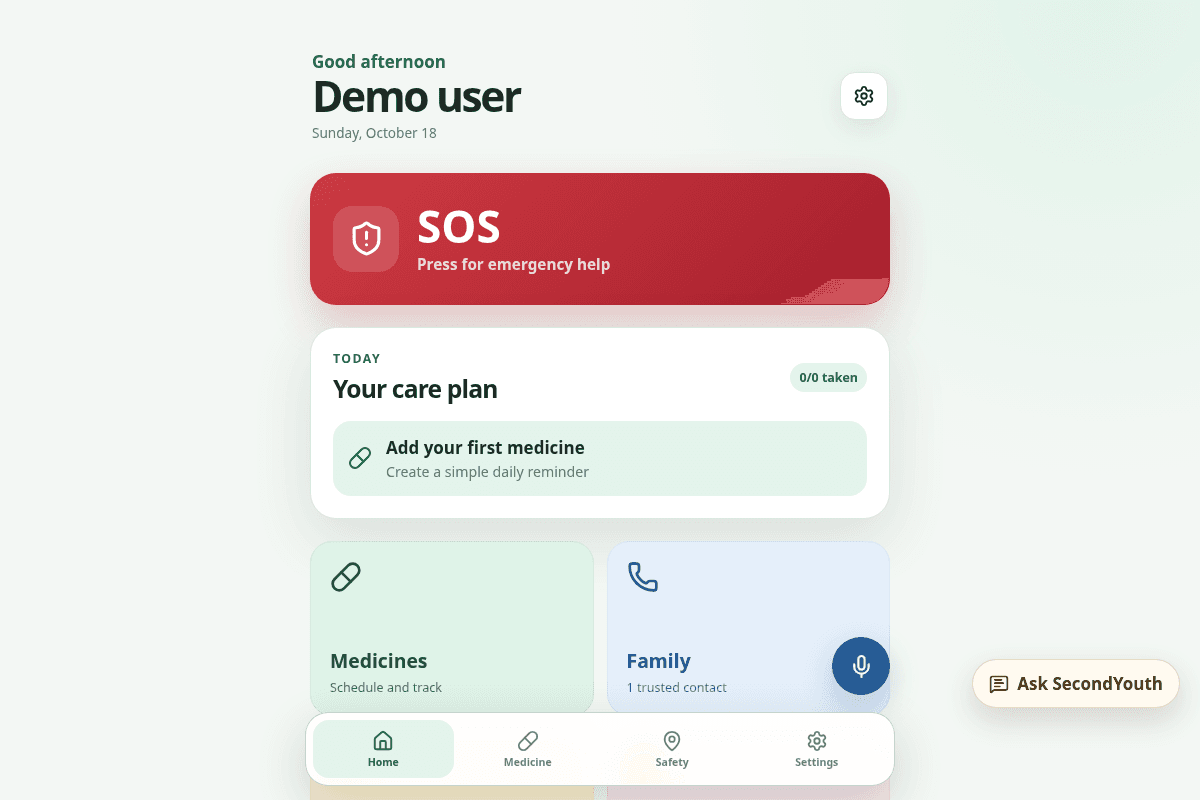
Actual application capture · Local product demo · Synthetic profile and contact data
Start with the friction.
Everyday assistance is spread across reminders, contacts, and device features. For someone who needs a simpler interface, moving between those tools is part of the problem.
Why it matters
Large controls and clear language help, but reliability also means keeping ordinary routines usable when a network connection is unavailable.
What the work contains.
The work shown is the application maintained in my public repository: device onboarding, medicine schedules, trusted contacts, and accessibility preferences, with an optional Node API foundation.
Give each part a job.
- 01
Start with the device
React renders the product flows. Versioned localStorage records keep profile, settings, contacts, medicine schedules, and SOS history on the device.
- 02
Use browser capabilities carefully
IndexedDB stores audio memories; geolocation and media APIs are requested for explicit actions. Camera recognition scenarios are labeled demonstrations.
- 03
Separate the optional backend
An opt-in Node API contains signed tokens, rotating refresh sessions, rate limiting, structured errors, and a safety-bounded assistant. The offline demo does not require credentials.
Boundaries are part of the design.
Local-first storage is usable without an account, but it does not provide encrypted cloud sync, durable notifications, or production identity. A local lock screen is not server-validated authentication. The demo is not a medical device or an emergency-service guarantee.
Evidence before confidence.
Ran the repository’s npm run check at the linked revision: ESLint passed, 7 domain tests and 5 server tests passed, and the Vite production build passed. Screenshots were captured from the running local application using synthetic demo details.
Evidence reviewed on 18 October 2026 at the source revision linked below. Local checks do not establish production readiness.
There’s a next iteration.
Offline-first product demo. Validate the interface with its intended users, then address identity, consent-aware sync, durable notifications, and security/privacy review before any real-world healthcare use.
Read past the story.
The source links point to the exact revision reviewed, rather than a moving branch.
- Product scope and boundaries
README.md - Local state and persistence
src/lib/appStore.js - Domain test suite
src/lib/appStore.test.js - Server verification
server/test/server.test.mjs